
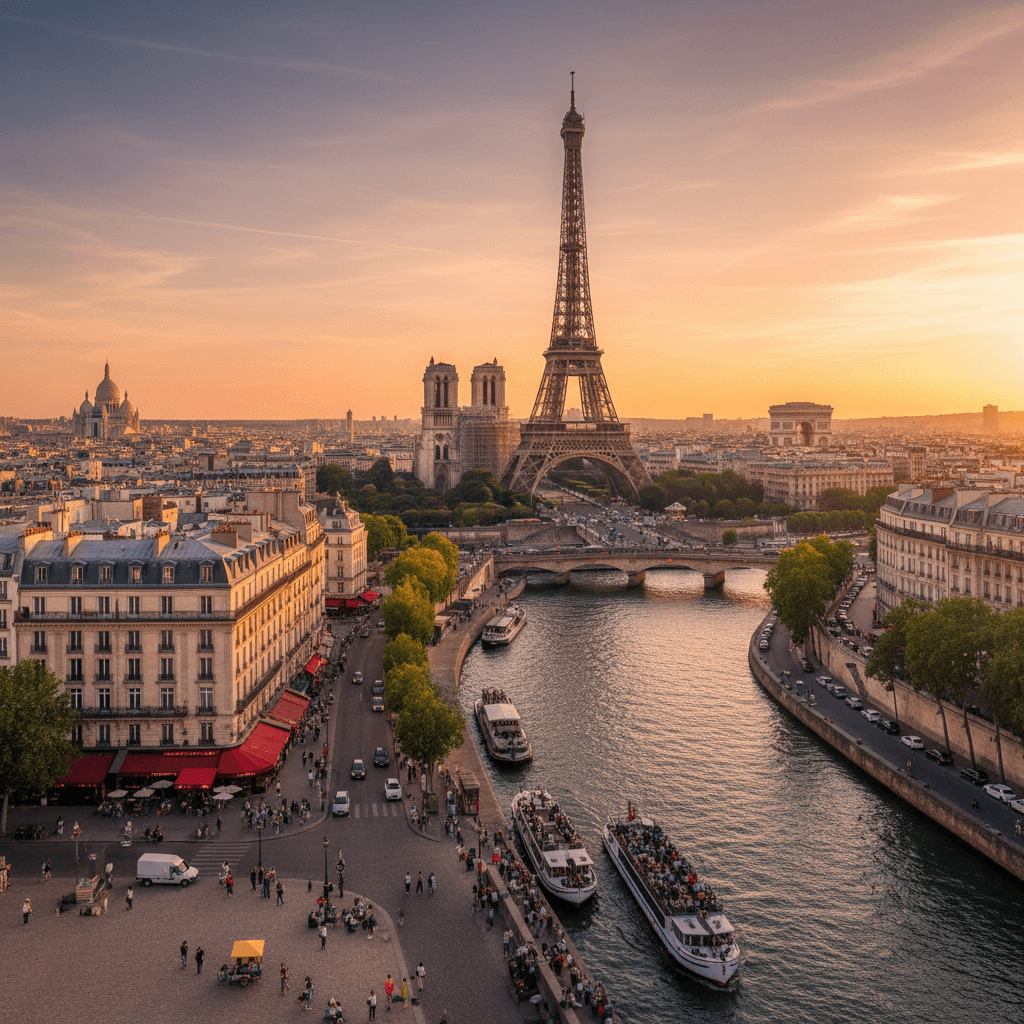
Paris
France · Île-de-France
Paris, located in the Île-de-France region, is the capital and largest city of France, set along the River Seine in north-central France. It is one of the world’s leading centers for art, fashion, gastronomy, and culture and anchors a metropolitan area of over 13 million residents.
Best time to visit
The most pleasant times to visit Paris and the Île-de-France region are typically in spring (April–June) and early autumn (September–October), when temperatures are mild and crowds are somewhat more manageable than in peak summer.
Language
French
Currency
EUR
Interesting facts
- Paris sits at the heart of the Île-de-France region (often called the Paris Region), which is the most populous of France’s 18 regions, with over 12 million residents and nearly one-fifth of the country’s population concentrated on about 2% of the national territory. This density makes its urban planning, transport system, and green spaces particularly significant for everyday life and tourism.
- Beyond the city proper, the Paris Region includes world-famous sites such as the Palace of Versailles, the Palace of Fontainebleau, and Disneyland Paris, which was the most-visited tourist attraction in France in 2017 with about 14.8 million visitors. These attractions help make Île-de-France one of the world’s top tourist destinations, recording an estimated 50 million visitors across all accommodation types in 2017.
- Paris is located on the Seine River and includes historic river islands such as the Île de la Cité, one of two natural islands in the city. Île de la Cité is home to major institutions including the Palais de Justice and historically the Cathedral of Notre-Dame, making it a symbolic cradle of Parisian and French history.
- The administrative region of Île-de-France comprises eight departments: Paris, Essonne, Hauts-de-Seine, Seine-Saint-Denis, Seine-et-Marne, Val-de-Marne, Val-d’Oise, and Yvelines. Inner-ring departments such as Hauts-de-Seine, Seine-Saint-Denis, and Val-de-Marne form the Petite Couronne (“little crown”) around Paris and are now part of the Métropole du Grand Paris, highlighting how the capital and its suburbs function as a single large metropolitan area.
- Despite being France’s richest region economically, Île-de-France has seen rising income inequality and housing pressures, with official data showing a poverty rate of around 15.9% in 2015. This contrast between wealth and social challenges is visible in the differences between central Paris, affluent suburbs, and less advantaged areas, especially in some parts of the outer suburbs.
- France overall is the world’s leading tourist destination, receiving about 102 million foreign visitors in 2025, and Paris is the country’s main cultural and economic hub. The city and its region play a central role in France’s global reputation for art, science, philosophy, and cuisine, and host numerous UNESCO World Heritage Sites and globally recognized cultural institutions.
Local tips
- Use public transport extensively: the Métro, RER, trams, and buses in Paris and across Île-de-France are dense and efficient, but can be very busy during rush hours (roughly 7:30–9:30 and 17:00–19:30), so plan major cross-city trips outside those times if possible.
- If you plan to visit sites outside central Paris such as Versailles, Disneyland Paris, or Fontainebleau, budget extra travel time and check which transport zones and tickets you need, as these trips often require specific RER or regional train tickets rather than standard Paris Métro fares.
- Popular attractions in the Paris Region can have long queues, especially in peak season; booking timed tickets online well in advance for places like the Louvre, Eiffel Tower, Versailles, and Disneyland Paris helps you avoid delays and sometimes secures better prices.
- Accommodation prices in central Paris are high; consider staying in well-connected suburbs in the Petite Couronne (for example in parts of Hauts-de-Seine or Val-de-Marne) that are close to RER or Métro lines, balancing cost savings with reasonable commuting times into the city.
- Paris and much of Île-de-France are very walkable, but distances on maps can be deceptive; combine walking with public transport and wear comfortable shoes, especially if you plan to explore multiple neighborhoods or large palace grounds like Versailles in a single day.
- Keep informed about any demonstrations or large public events, which are relatively common in Paris and can cause temporary transport disruptions or localized closures; check official city or transport websites and follow local authorities’ instructions if routes are blocked.